Review for Sigma 135mm F18 Dg Hsm Art Lens for Sony E Mount
Sigma 135mm f/1.viii Review
Updates:
04/14/2017: Technical Review posted
04/28/2017: Field Exam & Gallery Images posted
Sigma 135mm f/1.8 Field Examination
Fast and sharp? Insanely shallow depth of field? Sign me upwardly!
By Dave Pardue | Posted: 04/28/2017
Equally you've likely already seen from our full technical review of this lens by our experienced senior lens reviewer Andrew Alexander, this is one of the sharpest, if not *the* sharpest, lens we've always tested. Due to minor differences in the way lenses are tested beyond differing sensor sizes, information technology's a bit catchy making the call for the absolute sharpest, but in any case, this ane rivals the all-time we've ever seen here in our xviii+ years of lens testing.
Lab results can reveal a peachy bargain, but sample images from the real world are the other half of the story, and nosotros always try and bring you a varied sampling of these for the most pop lens offerings. This lens is designed first and foremost with portraits in mind, so I fix out with that as a master goal, merely the results produced in combination with our Nikon D800E were then enticing that I plant myself pointing the lens at all style of subjects, particularly out and virtually in the dandy broad open up.
 |
| one/200s / f/2.2 / ISO 100 |
(Images have been resized to fit this page, cropped and/or altered in post-product, primarily to balance shadows and highlights equally needed. Clicking whatsoever image will accept you to a carrier page with access to the original, total-resolution file as delivered by the Nikon D800E. For additional images, access to RAW files and EXIF data please come across our Sigma 135mm f/one.8 Gallery page.)
On the superb Nikon D800E, the autofocus functioning in the field is nearly instantaneous, and the combination in tandem feels similar a super-high-end musical instrument. I experienced no instances of AF hunting, simply very fast and definitive locking onto subjects, and that includes a few lower calorie-free situations. I didn't endeavor anything in super-low light though for this laissez passer, but I still came away feeling very confident in the performance in the field altogether.
The lens feels rock-solid in the hands, and the focus band is quite broad and comfortable, with a dainty textured ribbing. The two biggest drawbacks with the lens are obvious ones that you already know: It's not at all lightweight, and there is no on-board IS, but these are both par for the grade for a lens of this kind. And so there'south weight, yes, but the comfortable and stable hold does assist in the lack of on-lath IS, and in combination with a high-stop full-frame photographic camera like the D800E, this offering feels right at home.
| |
| Sigma 135mm f/ane.8 for Nikon F mountain as shown on the Nikon D800E |
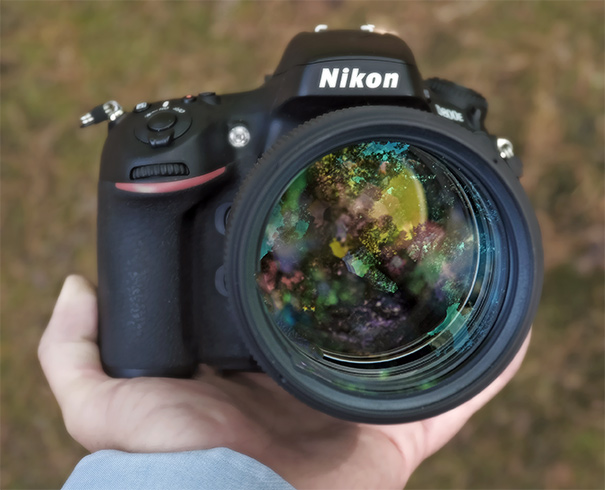
And what of the bokeh delivered from this venerable combination? I love it, but I will let the images speak for themselves. After all, bokeh is a personal affair. The nine rounded discontinuity blades are certainly configured to deliver the smoothest bokeh possible, and for my role as your faithful reviewer, I've tried to showcase plenty of varied image examples from different distances and locations for you lot.
So let's dive in and get a improve feel for what you lot can attain with this lens out in the existent earth!
Sigma 135mm f/ane.8 Portraits
 |
| 1/200s / f/ane.8 / ISO 125 |
 |
| i/200s / f/2.two / ISO 100 |
 |
| 1/125s / f/1.eight / ISO 100 |
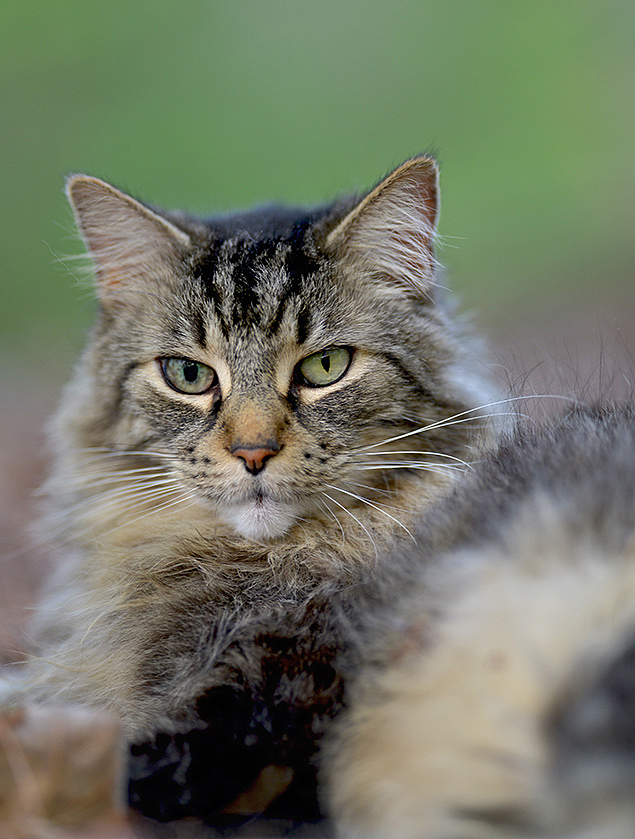
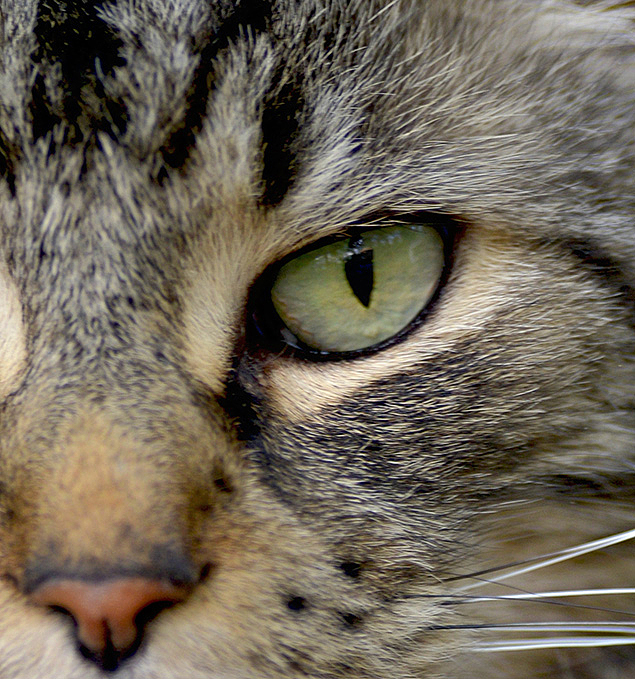
| Educatee depth: The shallow depth of field potential with this lens is almost razor-thin. At a minimum focusing distance of roughly three feet, which is about how far the D800E was from my favorite feline "Sam" in this prototype, the calculated depth of field using a handy DOF calculator shows the actual in-focus area to be about .2 inches, or about 5mm for the residuum of the world. That'southward about the width of a few thick coins stacked together. Below is a zoomed in crop, not quite ane:ane as I wanted to showcase the entire area around his center. I slightly missed nailing focus correct on his centre, which is non the mistake of the camera nor lens, but the point of focus is however virtually his heart, possibly ii-3mm in front of it (the stray strands of hair above his eye, for example). But what's interesting is how chop-chop the groundwork and foreground blur away into oblivion. For obvious reasons and then, information technology's important to proceed in heed just how shallow you tin can get, as nailing critical focus on important shots requires all the mental focus and care you can muster at a tolerance of just 5mm! |
 |
Portraits in Nature
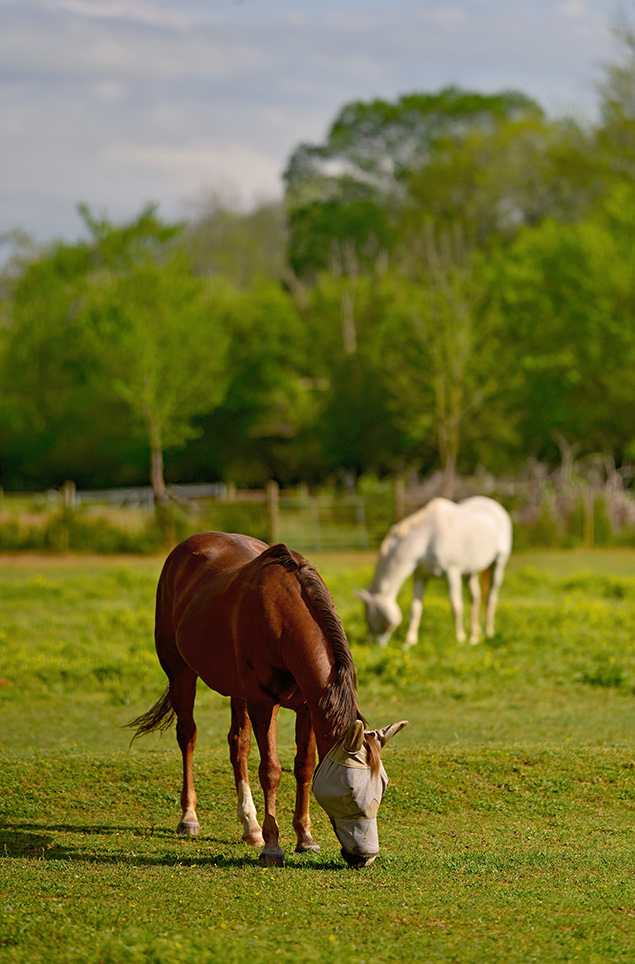 |
| one/8000s / f/2 / ISO 100 |
| Isolation: The is perhaps the most revealing image in this piece, because good subject isolation is a lot harder when you're not and so shut to your bailiwick. The longer reach afforded by 135mm in conjunction with the fast discontinuity allow for subject isolation that you simply can't get from a like altitude with traditional wildlife zooms sporting f/2.8 or smaller maximum apertures. |
 |
| 1/1000s / f/i.eight / ISO 100 |
| Surrealist compression: Again, another case of a subject fabricated much more interesting by the long focal length in combination with the shallow depth of field isolation. Interesting juxtapositions seem easier to come by with so much compression afforded from the long focal length besides. |
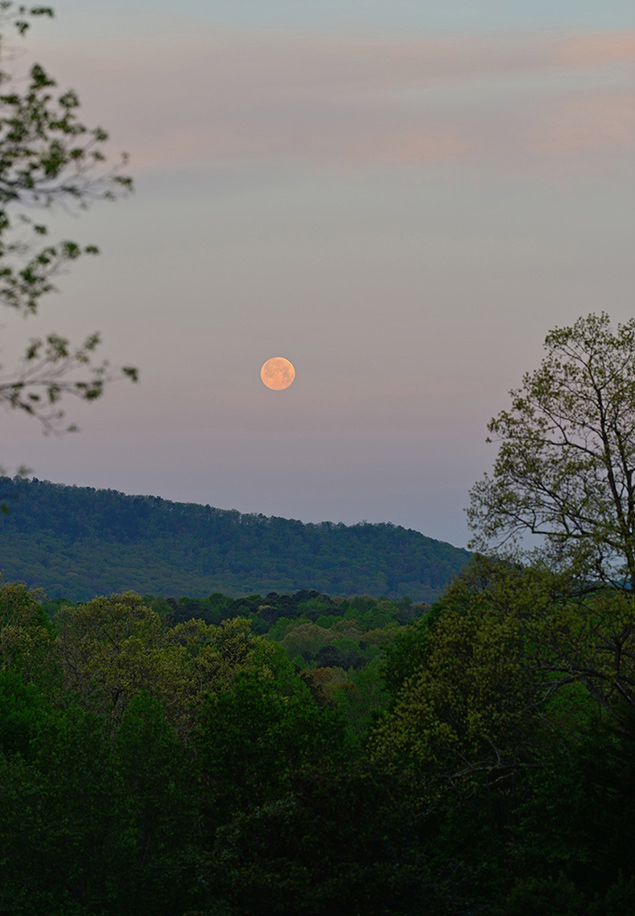 |
| one/160s / f/2.8 / ISO 100 |
| Blueish Ridge Moon: This was a versatile focal length to take at my disposal as I saw the full moon descending towards the Blue Ridge Mountains. I felt lucky in that it's rare to be able to capture any lunar details with the aforementioned exposure you need for the earth and sky, but the time of day allowed for information technology in this instance. Interestingly, the moon disappeared behind the cloud bank less than a infinitesimal later on this shot was captured, well before it got to the tree line, so I'm glad I didn't try and wait for the "perfect" shot (which then oftentimes doesn't exist). |
Bokeh Dreams
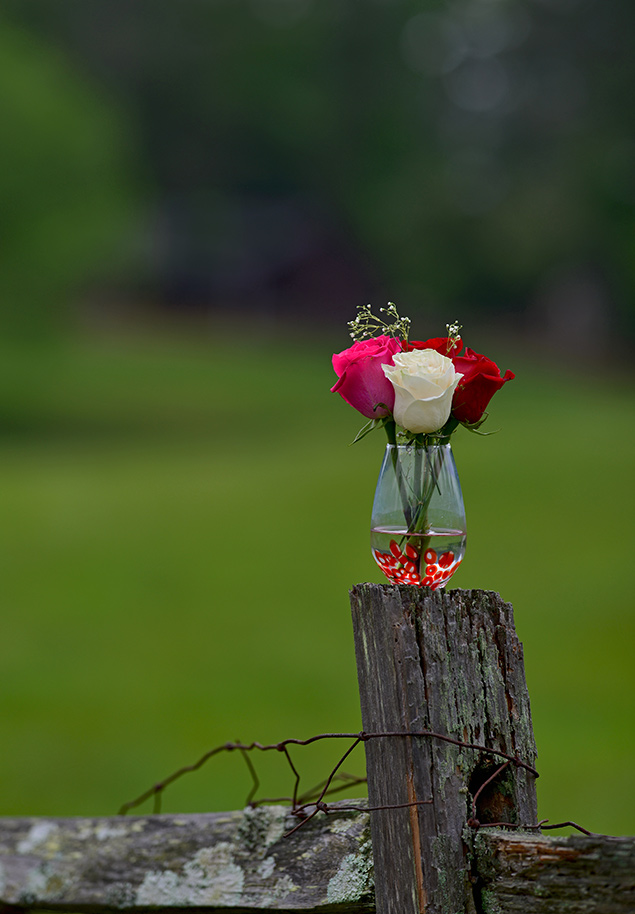 |
| 1/800s / f/2.2 / ISO 100 |
| The sublime: A rose by any other name might scent as sweetness, but the ones photographed by most other lenses wouldn't likely wait quite like this. |
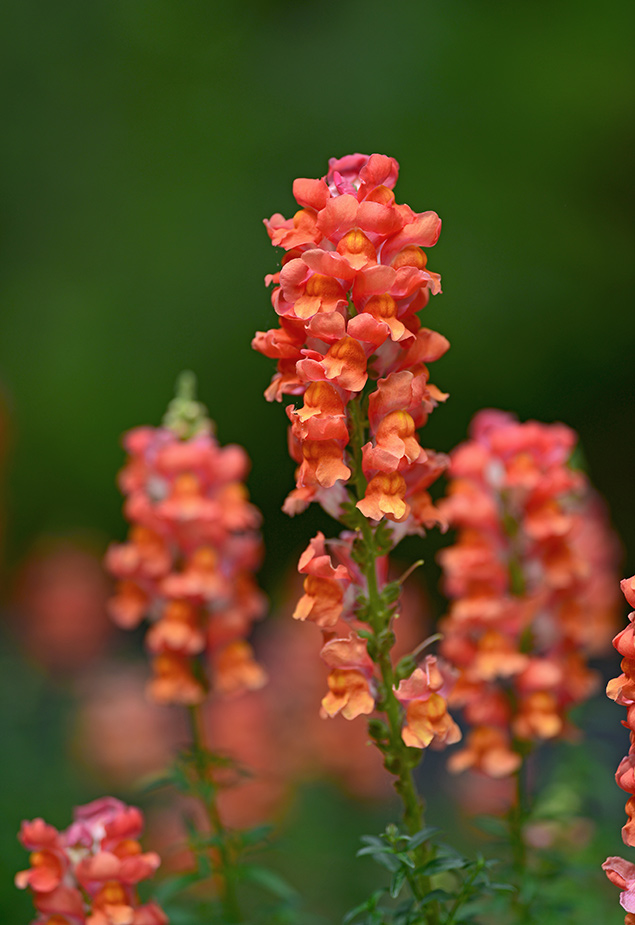 |
| 12500s / f/1.eight / ISO 100 |
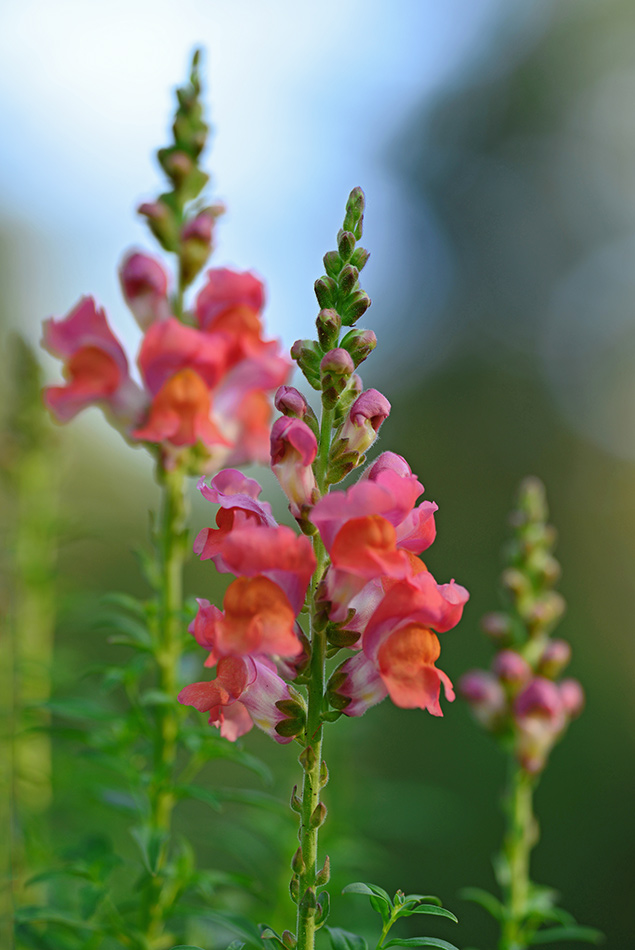
| Dragon's lair: These Antirrhinum are commonly known in the U.Due south. equally Snapdragons, a moniker given due to their dragon-like advent. And they certainly make for a compelling bailiwick on which to train your long, fast prime lenses. |
 |
| 1/250s / f/ane.viii / ISO 100 |
| The impressionist: The background of this shot reminds me just a bit of Van Gogh'southward "Starry Night" and offers a good representation of the overall bokeh appearance delivered by the 135mm lens shot wide open. |
Sigma 135mm f/i.8 Conclusion
After reviewing the images obtained through this hearty expanse of glass and past such a capable total frame camera, I tin can most convincingly agree with Andrew'southward earlier attestation to the Sigma 135mm f/1.8: It is, indeed, destined to become a mod classic. It is quite hefty and comes without on-lath prototype stabilization, yep, but the image quality and the myriad shooting possibilities offered past such a fast, long, abrupt lens more than brand up for these obvious trade-offs -- just be extra-careful in acquiring focus while shooting wide open.
Form follows role, and the function of this new Art lens from Sigma is to deliver works of simply that.
 |
| 1/2500s / f/iv / ISO 100 |
Run into more images from this combination in our Sigma 135mm f/1.8 Gallery. Access to RAW files is as well available.
• Sigma 135mm f/1.eight Art Gallery •
[Want to know more about bokeh in general? We have you covered... just click here!]
(Using our affiliate links at the top and bottom of this and other articles to make your gear purchases gets you the same low price, including whatsoever special deals, while helping us continue to be able to bring you these early on looks at the gear. Give thanks you!)
• • •
Sigma 135mm f/1.8 Art Technical Review
by Andrew Alexander | April 14, 2017
The 135mm prime number lens is a long-time favorite of portrait photographers, combining the compression of a telephoto lens with the thin depth-of-field of a fast aperture, resulting in really blurred-out backgrounds. Sigma's release of the 135mm ƒ/1.8 DG HSM "Fine art" is a timely and smartly-planned lens: current offerings by Canon and Nikon in this focal length are running a chip long in the tooth, released in 1996 and 1990, respectively.
The lens itself is relatively simple in design: 13 elements in ten groups with two big FLD ("Fluorite Low Dispersion") elements and two big SLD ("Special Low Dispersion") elements.
The lens accepts 82mm filters, ships with a round lens hood, and is available for US$1,399 in Sigma SA, Canon EF, Nikon F and Sony Eastward mounts.
Sharpness
In a discussion: precipitous. A few more words: absolutely sharp, one of the sharpest lenses nosotros've ever tested. Even used broad open up at ƒ/ane.8, on a full-frame torso, the lens produced almost no corner softness. With a lens at this level of quality, the only reason you lot want to stop down is to direct how much depth-of-field you desire in your paradigm; there is no need to consider the effect on sharpness.
Once you stop downwardly to ƒ/sixteen, nosotros do see some lite softness across the unabridged frame due to diffraction, but so at that bespeak, you're probably not using the lens as it was intended to be used -- wide open, every fourth dimension, all the time.
Chromatic Abnormality
The Sigma 135mm ƒ/i.viii DG HSM Art lens employs two types of low-dispersion lens elements, which demonstrably reduce the impact of chromatic aberration. In that location is a lite color fringing that occurs when the lens is used at its widest aperture, showing a slight fringe of regal in areas of high contrast. Otherwise, the lens is remarkable and does not show signs of longitudinal chromatic aberration, which are sometimes present in lenses featuring very wide apertures.
Shading (''Vignetting'')
The Sigma 135mm ƒ/1.8 shows some slight corner shading when used with its wider apertures on a total-frame camera body: at ƒ/i.8 on the D810E, nosotros noted extreme corners that were ii-thirds of a end darker than the center. In other cases, corner shading is negligible.
Distortion
The lens shows relatively no baloney.
Autofocus Operation
The Sigma 135mm lens autofocuses very quickly, racking from closest focus to infinity in about 1 2nd, cheers to its electronic Hyper Sonic Motor. In basic usage, autofocus was fast, locked onto targets easily and didn't hunt while focusing. Modest changes in focus happen very quickly, and the AF motor is almost silent. Attached 82mm filters won't rotate during focus operations.
Macro
While the Sigma 135mm "Art" isn't designed as a macro lens, information technology offers surprisingly good macro operation for its class. That said, at that place are certainly improve lenses for this purpose. The 135mm ƒ/ane.8 offers 0.2x magnification, with a minimum close-focusing distance of but nether three feet.
Build Quality and Handling
The Sigma 135mm ƒ/1.8 Fine art lens follows other recent Sigma lenses in terms of build quality, structure and design. The lens features their characteristic sleek, matte black finish and thickly gripped zoom and focus rings. The barrel itself is constructed out of Sigma'southward proprietary Thermally Stable Composite material, which allows for much tighter manufacturing precision compared to standard polycarbonate plastics. The lens, therefore, feels great in the mitt. The build quality is excellent and feels very solid.
However, you don't get this kind of operation without some serious weight. For a prime number lens, the Sigma is surprisingly heavy, tipping the scales at over 40 ounces. This is much heavier than both the Canon 135mm ƒ/2 and the Nikon 135mm ƒ/2 lenses, though for the performance, information technology is unquestionably worth it. The lens features nine curved diaphragm blades to make upward its aperture, which produce buttery-smooth results for bokeh.
The lens features 2 switches, the first used to activate or conciliate autofocus on the lens. The second is a focus limiter, which has three positions: 0.875m to 1.5m (a typical portrait distance: iii to 5 feet), ane.5m to infinity, or Full, where there is no focus limitation. A distance scale is provided with ranges indicated in anxiety and meters: there is no depth-of-field scale, nor is there an infrared index marker.
The focusing ring on the lens is generously-sized at 1 seven/8" broad, composed of rubber with a deeply ribbed texture. The ring has soft stops that let you know y'all have reached either stop of the focusing spectrum, and autofocus results can exist overridden by just turning the band at whatsoever time. Likewise, employing autofocus does not turn the focusing ring, making the feel quite seamless.
The lens ships with the LH880-03 round lens hood. The hood is bayonet mounted, reversing and attaching to the lens for storage.
Alternatives
Nikon 135mm ƒ/two AF DC ~$1,400
Released in the early on nineties, the Nikon 135mm ƒ/2 offers its unique defocus control applied science. We oasis't tested this lens, but can say that it uses an older mechanical autofocus engineering science rather than Sigma'due south hypersonic motor.
Canon 135mm ƒ/2L USM ~$1,000
Catechism offers two flavors of 135mm lenses: the regular ƒ/2L, and a soft-focus ƒ/2.eight. The ƒ/2L lens is almost every bit sharp as the Sigma at wide apertures: stopped-downwardly to ƒ/4, they are quite like in graphic symbol.
Sony 135mm ƒ/1.8 Carl Zeiss Sonnar T* ~$1,800
The most expensive of the 135mm lenses, Sony'due south offering matches the Sigma for its discontinuity capability, merely Sigma knocks the Sony out of the park with its sharpness. On a full-frame A900 the Sony 135mm has to stop down to ƒ/eight to achieve the aforementioned edge-to-edge sharpness the Sigma achieves at ƒ/2.
Carl Zeiss 135mm ƒ/2 APO Sonnar T* ~$i,500
We haven't tested the Carl Zeiss 135mm, but Zeiss lenses are renowned for their sharpness. In this case withal, you lot are also forgoing autofocus every bit the lens does not come equipped with it.
Conclusion
The Sigma 135mm ƒ/i.8 DG HSM "Art" is one of the sharpest lenses we've ever tested. It'south not an inexpensive lens, but for what you get -- keen build quality, outstanding sharpness, little to no chromatic aberration, and almost aught distortion -- the lens is worth every penny, and destined to get a modernistic classic.
Product Photos
| | | | | | | | |


Sample Photos
The VFA target should give you a practiced idea of sharpness in the heart and corners, as well as some idea of the extent of barrel or pincushion distortion and chromatic abnormality, while the Still Life subject may assistance in judging dissimilarity and colour. We shoot both images using the default JPEG settings and manual white balance of our exam bodies, and then the images should be quite consistent from lens to lens.
Equally appropriate, nosotros shoot these with both full-frame and sub-frame bodies, at a range of focal lengths, and at both maximum discontinuity and ƒ/8. For the ''VFA'' target (the viewfinder accuracy target from Imaging Resources), nosotros also provide sample crops from the middle and upper-left corner of each shot, so you can chop-chop get a sense of relative sharpness, without having to download and inspect the full-res images. To avoid space limitations with the layout of our review pages, indexes to the examination shots launch in dissever windows.
Sigma 135mm f/1.8 DG HSM Art
Your purchases back up this site
Catechism EF - Black
- Buy from Amazon for $1,209.95
- Purchase from Adorama for $1,399.00
- Purchase from B&H Photograph for $one,399.00
- Purchase from Amazon for $1,369.95
- Purchase from Adorama for $1,399.00
- Buy from B&H Photo for $1,399.00
- Buy from Amazon for $one,322.53
- Purchase from Adorama for $899.00
- Search on B&H Photo
- Buy from Amazon for $1,399.00
- Buy from Adorama for $1,399.00
- Buy from B&H Photo for $1,399.00
Sigma 135mm f/i.viii DG HSM Art User Reviews
-
10 out of 10 points and recommended past lightknight (31 reviews)
Precipitous, sharp, sharp, beautiful bokeh, built like a tank
Heavy...
This lens is everything reviewers say. The lack of VR/IS is a non issue with my Sony A7R3, while the extra 1/3 of a stop over my previous Nikkor 135 F2 DC is always handy. The Bokeh is the equal of the legendary Nikkor but much easier to use. Just information technology is heavier and bigger and then carrying information technology a long manner (it weighs 2.one KG with my A7R3 with an L plate and the hood) is an upshot if you are out for the day.
reviewed February 27th, 2019 (purchased for $1,175)
Lenses don't go any better than this :-)
Source: https://www.imaging-resource.com/lenses/sigma/135mm-f1.8-dg-hsm-art/review/

Postar um comentário for "Review for Sigma 135mm F18 Dg Hsm Art Lens for Sony E Mount"