Philly chefs visit their favorite restaurants: Wilson Tang at Saté Kampar
Feb. 12, 2020


One of Philadelphia'south best dim sum spots is a sleeper. It's rarely packed, hasn't had a major review, doesn't make the usual roundups and all-time-of lists, and most people I commend it to say, "Hmm," in vague recognition.
That'southward surprising, because its New York Urban center location is Chinatown'due south oldest continuously operating restaurant, a dim sum hall since 1920.
Possessor Wilson Tang has three NYC restaurants, employs 150, and operates to fiscal success and critical acclaim with plans for more units, licensing agreements and an expanded production commissary.
A pocket-size spot—38 seats with another 12 at the bar, Nom Wah Philadelphia has a modernistic feel, full bar, efficient if brusque service and some of the best dim sum in Philly.
Nom Wah's signature item, the OG Egg Scroll, is a lesson in culinary etymology.
Predating the shop-bought wonton wrapper, Tang says, push button and woods ear mushrooms, cabbage and h2o chestnuts are stuffed inside an egg crepe, then battered and fried.
The result is a tenderer version of the standby, yielding to chewiness without vegetable stringiness, and delivering rich umami beyond the confines of its plant-based filling.
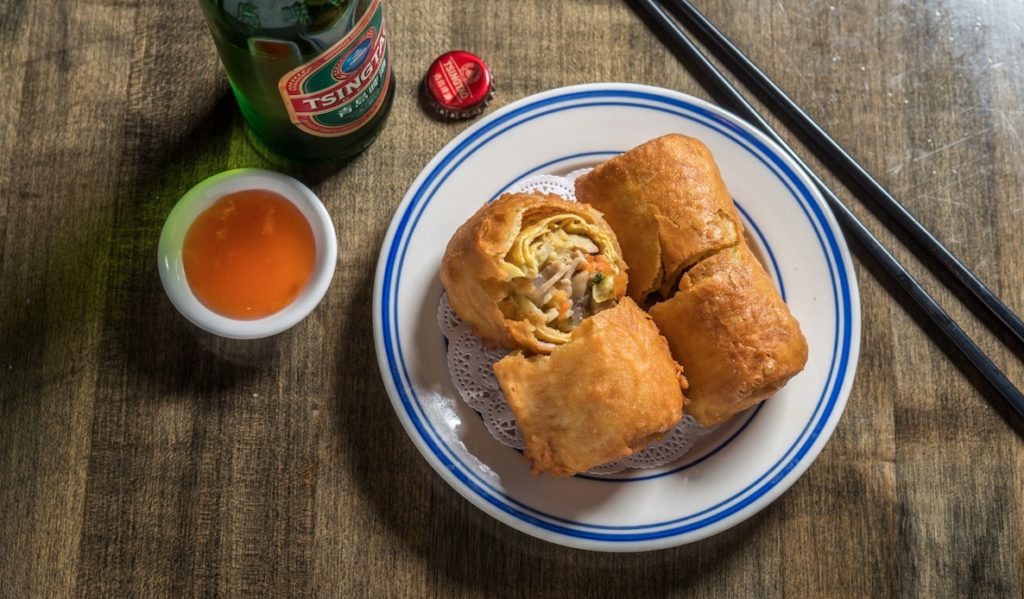
If nothing else, the dish should enter the pantheon of Philly'due south great vegetarian drinking food along with the socca at Skillful King Tavern, the buffalo cauliflower tacos at Bar Bombon and the dan dan noodles at V Street.
The char siu bun, an item ubiquitous in Chinatown, is washed properly here, with melt-in-your rima oris pork, not too cloying, in a softball-sized bun.
The shrimp dumplings and Shanghainese soup dumplings are imported from Tang'due south commissary in New York Metropolis, allowing Philadelphians in the know to have a gustatory modality of the Doyers Street legacy without the bus ride.
Opened in 2015, Nom Wah Philadelphia sits on a sleepy nondescript cake of North 13th Street, in the shadow of the Convention Heart. It attracts some savvy foodies visiting a local shrine, confidently navigating the notepad order class menu of forty dim sum options.
Merely on my last visit, the room was dominated by a big tabular array of conventioneers on a budget ("booze on a dissever cheque delight!") asking if the spice in their General Tso's chicken could exist "toned down." The NYC locations don't fifty-fifty have American Chinese food.
 Tang says, "In New York, if you lot don't like it, I tin tell you to fuck off. In Philly, I need to find means to capture that market since it'due south much smaller. I'g not trying to do inexpensive food or high-end nutrient—I have a thin band correct in the center and it's thinner in Philly than New York."
It'due south heartbreaking for me to see someone who doesn't know what they are missing inquire for an off-bill of fare chicken fried rice rather than experiencing the sublime balance of the shrimp and snowfall pea leaf dumplings.
Tang laughs information technology off. "If that's what people want, I'll do it," he says. "My margins are meliorate and there's much less skill required on the back end to make General Tso's or lo mein [than hand-formed dim sum]. The concluding affair I would wish on a person in the eating house business is to piece of work 90 hours per week and non make a skilful living. If one person asks me to brand ma-po tofu I may tell them to fuck off. But after four or 5 [requests], Nom Wah volition have ma-po tofu on the menu."
Tang's gift is balancing art and commerce.
He does it in his eating house—reproducing family dim sum recipes dating to the early on 20th century while simultaneously disavowing tradition to reframe dim sum as tapas for a wider audience—serving it over lunch and dinner rather than traditional breakfast and lunch to align with demand; encouraging pairing with beer, wine and cocktails as one does with small plates throughout Philadelphia across Chinatown.
Just balancing art and commerce also encapsulates Tang's career. He worked for Morgan Stanley in the World Trade Center until surviving 9/11 prompted a grand reprioritization of his career path. Nutrient and family matter.
When I asked Tang who in Philly is serving nutrient he respects, where he wanted to become for this column, he texted back without hesitation: "Get-go selection, Saté Kampar."
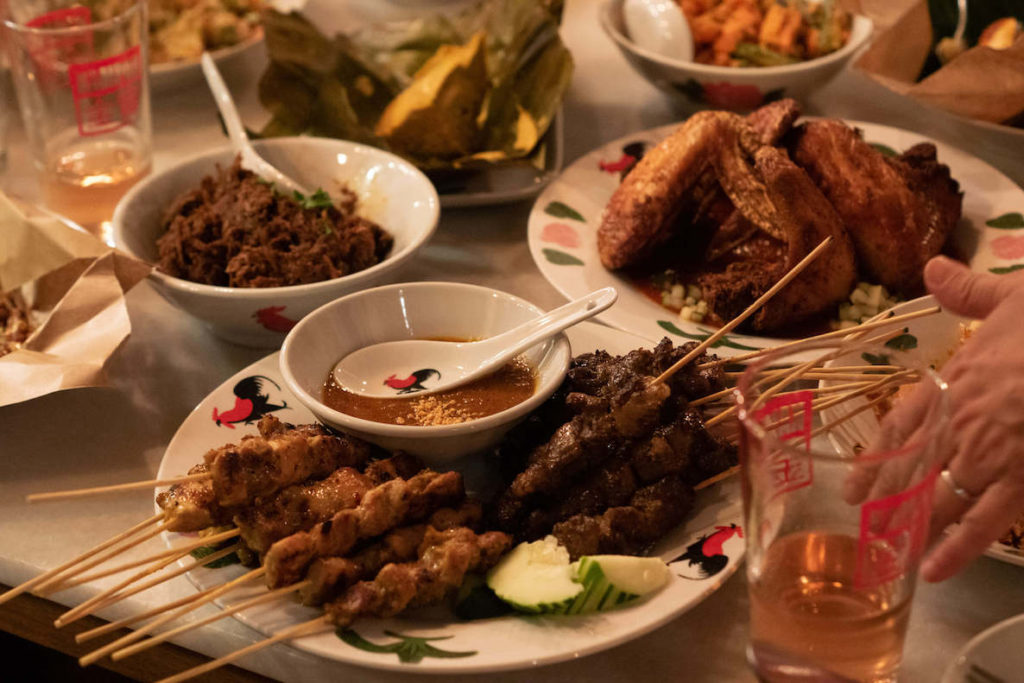
Opened by Ange and John Branca in 2016, Saté Kampar introduced many Philadelphians to Malaysian nutrient with great buzz, acclaim and a James Beard semifinalist nod.
A 49-seat BYOB with a modest open kitchen, dining room dominated by a java and tea bar, the vibe was loud and lively, fifty-fifty tardily on a Mon when nosotros visited.
The dining room was filled with immature couples (many of them restaurant workers themselves) and groups of friends splitting magnums of cheap wine and 6 packs of beer.
Where Tang tries to arrange his market, Branca unapologetically cooks her food as she pleases.
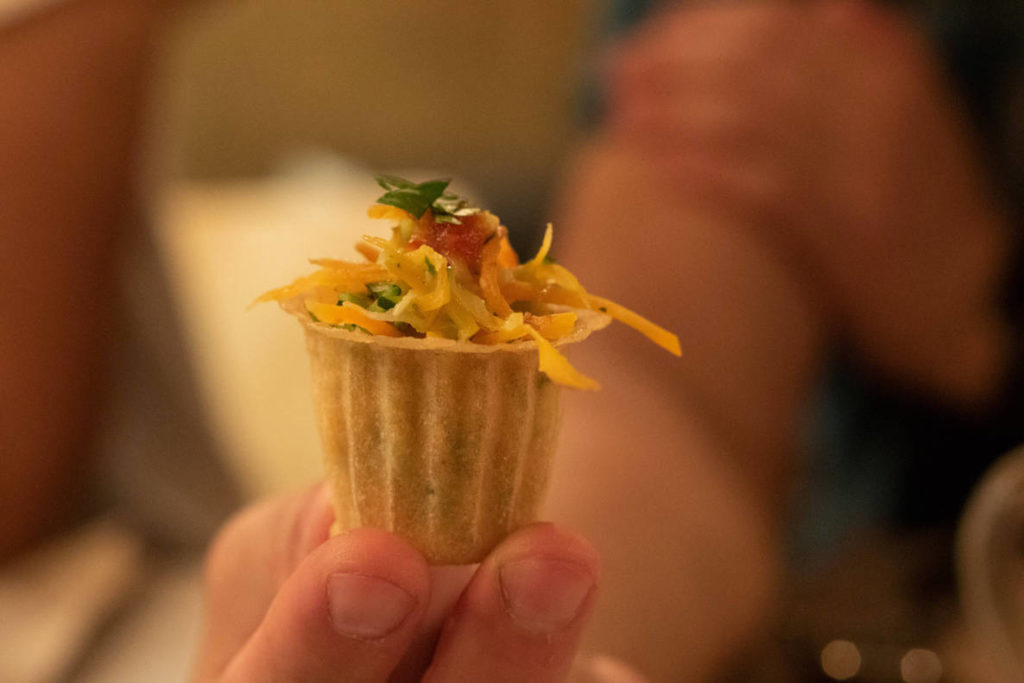
Tang says, equally our pie tee, petit rice flour and egg cups blimp with shredded carrot and jicama, arrive, "This is a very honest place for me. At that place are very few people similar Ange who are so passionate. Information technology's why this place is so successful."
While Saté Kampar serves halal meat (Islam is the majority and state religion of Malaysia), the familiar carte du jour argument to let the server know if you lot have allergies and then that the restaurant tin can accommodate is here replaced past, "Please be enlightened that our eating place uses ingredients that contain all the major FDA allergens."
Hyperallergenic dining: a different kind of no f'south given from Tang'southward.
The menu is succinct, making it possible to eat nigh all of it, as we did. The top half offers six varieties of Saté (chicken ii ways, beefiness, goat, tofu and pork), which Branca points out should exist eaten every bit a primary course and in affluence, rather than as a single-stick Americanized, bougie cocktail appetizer. Go the goat.
The bottom one-half consists of two rice dishes and 1 noodle dish meant to be eaten individually ("Malaysians don't share rice"—we broke that rule within 10 seconds); and lauk, shareable dishes—1 each of beef, chicken and fish, along with a salad and pickled vegetables.
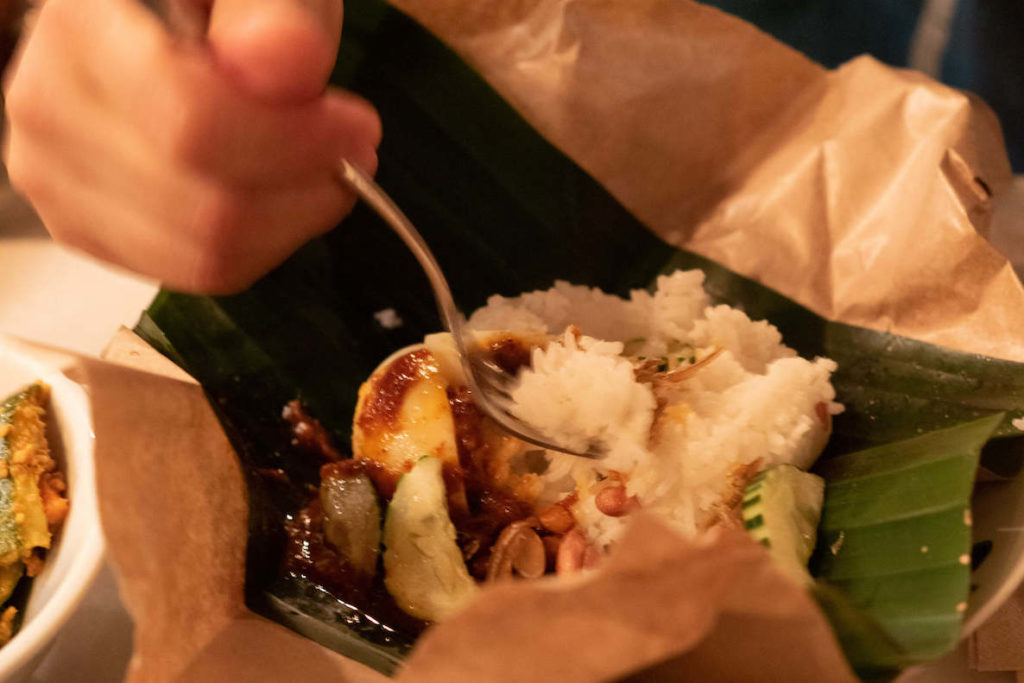
A standout that made u.s. swoon was the nasi lemak bungkus, a banana-leaf-wrapped packet of steamed coconut rice, accented by sambal, peanuts, tiny dried anchovies and hard-boiled egg, the menu description of which reads, in part, "Essentially a fragrant, flavorful, magical packet of Malaysian awesomeness."
Somehow in Branca'southward hands, it is not hyperbolic. Even if you lot break the rules and share, angle to be the one to open the packet and so you get a face full of aromatic steam, the aforementioned magic. Branca has a story for every dish on the card—this one was her breakfast before schoolhouse in Malaysia.
A card description that undersells is the otak-otak nyonya, the "fluffy fish soufflé," a clarification that makes it sound like something served at an orphanage in a children's book. On past visits I was turned off by what sounded to me similar curried gefilte fish so hadn't ordered it. Big error.
Branca's dish rivals Pierre Calmels's quenelles at French restaurant Bibou for lightness and technical precision, but with redolent spices—ginger, galangal, turmeric, lemongrass and betel leafage—combined with male monarch mackerel, egg and kokosnoot foam—that kept us going dorsum for more to identify each component.
Where nasi lemak bunkus is luscious and aromatic, the other rice dish, nasi ulam, is fresh, artfully arranged shredded fish, kokosnoot, herbs, bean sprouts and sambal on a mound of rice, to be combined together into a salad at the table.
With Ku-Mah's achat, twice-pickled vegetables flavored with sambal, the dishes together serve every bit a refreshing foil to the meat (or tofu) Satés and main meat dishes, the rendang daging, a slow-braised beef (remember Malaysian ropa vieja), and ayam kurma, a coconut-based potato and chicken stew.
Too many BYOBs write off their beverage programme equally a non-starter given that they don't have a liquor license. Saté Kampar makes it a signature with an extensive kopitiam (coffee shop) card likewise every bit coconut and ribena (black currant cordial) drinks. The beverages hither are very much part of the dining experience.
Where Tang strives to make his menu accessible to the broader Philadelphia market via translations and familiar dishes, Branca is charmingly but resolutely uncompromising. Where Tang's philosophy is one of balancing art and commerce, Branca's is motivated to distinguish between survival and intent: "I'yard here to tell a story. To put a spotlight on this kind of cuisine. The reason I'g hither is to piece of work on growing a community. A lot of this is lost cuisine even in Asia."
As Tang says, "Every dish at Sate Kampar has a story. And every fourth dimension I've been here Ange is here to tell information technology. I don't call back what the f**chiliad she says, just I love that…for me, I'k hither to make new authenticity."
Similar the cuisine of Malaysia, which draws heavily from China, Southern asia and Europe, Branca was shaped by multiple cultural influences. She has no single beginning linguistic communication, growing up speaking—and thinking—in Chinese, English and Malay.
She was educated by Irish nuns in Malaysia and studied accounting and business computing at Heriot-Watt Academy in Scotland. Branca originally came to Philly in 2000 every bit a Deloitte consultant.
Like Tang, her ability as a restaurateur is informed by her education and feel in the corporate world. Unlike Tang, she's less interested in using her business organisation chops to meet customers where they are. She is on a mission to have guests acquire the cuisine of her childhood, every bit well every bit those of her chef colleagues cooking the cuisine of their own cultures.
 "I hope there will be a point where people talk to the chef [to ask questions and empathise the cuisine]," Branca says. "I detest calling us ethnic but don't know a better word. We're educating diners so restaurateurs can operate with intention."
Her advice to guests? "I created a eating place with intent. I don't bend over backwards. Be patient and don't drive business organization owners to do things they don't want to do."
Branca'due south goal is to bring us together over something all Philadelphians tin concur with—proficient food, lovingly prepared, is worth jubilant. "Anyone who tries to understand the other is more cultured," she says. And in the social media age, it is easier than always to acquire about the food of others.
As Tang says, "Every dish at Saté Kampar has a story. And every time I've been hither Ange is here to tell it. I don't recollect what the fuck she says, but I dearest that…for me, I'm here to make new authenticity."
Next month: Ange Branca from Saté Kampar takes us out.
Jonathan Deutsch is a professor of Food and Hospitality Management at Drexel University. This story is part of a serialized book running in The Citizen throughout the year.
Photos by Danya Henninger 
Source: https://thephiladelphiacitizen.org/wilson-tang-sate-kampar/
Postar um comentário for "Philly chefs visit their favorite restaurants: Wilson Tang at Saté Kampar"